

Together
What is Together?
An app that would help improve the quality of life by supporting active human connectivity. We aim to promote and encourage community engagement by providing a means for a community-wide bulletin board.
My Role–
Research, UX/UI, Prototyping, Visual Design
Team–
Jalyn Metra-Lopez, Jeffrey Chu, Amer Abban, Alex Malvaez
Tools–
Figma
Skills–
User Research, User Testing, Competitive Analysis, Persona & Storyboard Building, Stakeholder Interviews, Style Guides and Mood Board Creation, Wireframing, Iterative Design, Prototyping
CONTEXT.
The Problem–
In every community, there are always local opportunities and resources, but it is not always obvious where to find them and how to get involved. Though everyone can say they are a part of a neighborhood, not everyone say they are a part of a community. Especially with the distance that the coronavirus pandemic forced between us, it can be difficult to be informed about all different things that happen in your direct district, whether that be about summer events in the park, local Covid testing sites, or someone that had their car broken into on the street next to yours. That being said, my team and I aimed to bridge the gap between members of a neighborhood and provide means of communication that would unite them as a community.
Inspiration-
Given the prompt of designing for “creative social life” with regards to COVID-19, my team and I brainstormed ways of how the pandemic has affected us both negatively and positively, and how we as designers can ultimately use that to our advantage and create something that would improve the quality of life. When COVID comes to mind, we automatically are reminded of the restrictions placed upon us and distance forced between us and how we are faced with new challenges that we never before had to overcome. After reflecting on all the different apps we use daily such as Facebook, LinkedIn, Twitter, and even Ring, we came up with an idea to essentially combine those in a way that connects an individual specifically to its direct and local community. The definition of a community is: a feeling of fellowship with others as a result of sharing common attitudes, interests and goals. Through Together, we emphasized that feeling of fellowship by providing a means of support and communication to your neighbors. And despite being made under the influence of COVID-19, this can very well be used post pandemic because there will always be new opportunities and announcements to share with ones community.
USER RESEARCH.
Personas-
.webp)
Gerald,
a 42 year old graphic designer with an 8 year old son who just moved to a new city. He wants to get acquainted with other families in the area but doesn't know where to start.
.webp)
Leila,
a 17 year old high school senior and a soon to be a first-gen college student. She is unaware of how to find educational resources.
Storyboards-

Matt recently relocated to a new city for his new job. He wants to get involved and get acquainted with the folks of his community but unsure how to go about meeting people.
He downloads the community ran app to find a local book club with folks in his immediate neighborhood.
He is now able to view and browse local groups that are dedicated to various activities.
The app has not only helped Matt find a book club but also connected him to people int he city that is his new home.

Michelle is struggling in school and needs extra help!
Michelle's parents are worried about her grades. They cannot afford a professional tutor and don't know how to find local help.
Michelle's mom's coworker introduces her to a community ran app. She makes a post about needing a tutor for her daughter.
Jasmine, a student at their community college, sees the post and offers to help Michelle.
Competitive Analysis-

Competitor A is Facebook.
Facebook is a great generic social media platform that connects people in many ways for different reasons. A popular way that Facebook is utilized is through Facebook groups. Through Facebook groups, people may join and share photos, make posts and make events. It is a very common and easy way to connect people for many different reasons, but there are an abundance of fake accounts, there can be duplicate groups for the same things and also that there is a lot of fake news that circulates Facebook. Facebook for the use of community connectivity is very broad and although can serve the purpose of our goal, is very open and can be disorganized.
Competitor B is the app called Nextdoor and Competitor C is the app called Neighbors.
Both of these platforms resemble each other and cater more towards our goals. Both of these are neighborhood watch apps that aim to bring neighborhoods together by helping citizens engaged through posts, safety, crime awareness and lost & found. The downsides to these apps are that they can create a false sense of fear and promote racial profiling and can be a hot bed for low level crime scammers. Neighbors is founded by Ring and therefore users are forced to have a neighbors account when they buy a Ring product (doorbell, security cameras, etc).
And finally, Competitor D is an app called Meetup.
This app primarily focuses on community engagement in the aspect of group events. Users can input their interests and join creative, social, and career oriented groups and meet people that share their same interests and even attend and host events. While this does promote community engagement, people can adjust their location radius therefore almost anyone can join a group. Events are at the discretion of the user because essentially the people you are interacting with are strangers.
These competitors all serve different aspects of our design and we hope to put all the positive elements together into one. Our team gravitates towards the ideas of promoting community engagement and unity through safety/crime awareness, and lost and found. However one aspect that none of these platforms have is the specific ability to share resources. We want to enable a feature where members of the community can share different resources and posts regarding different resources such as volunteer opportunities, SAT prep, community workshops, etc.
DESIGN PROCESS.
Moodboard–

Style Guide-

Features–
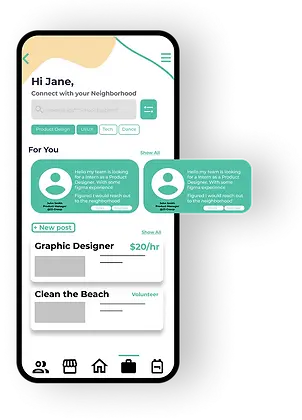
Geared towards creating a hub of opportunities for users
-
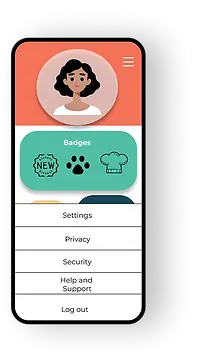
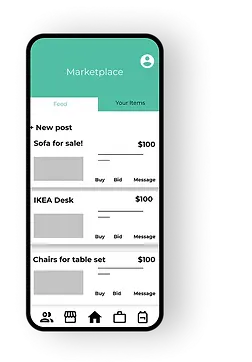
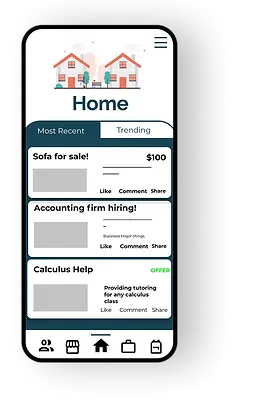
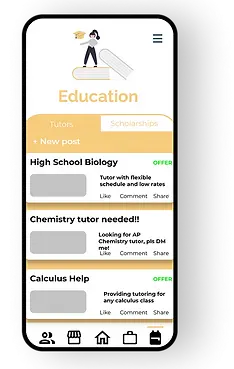
Hubs/tabs: Marketplace, Education, Social, Opportunity
-
Users can post recommendations, advertisements, events and more
-
Central platform for multiple different needs
01.
Creates a sense of community by bridging the gap between neighbors
-
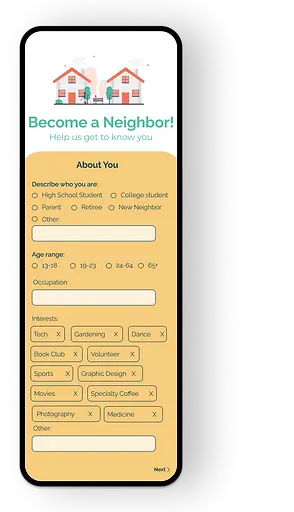
By being verified by where you live, it enables members to connect with each other
-
Provides a sense of community by allowing local outreach
-
A means of network for local resources
02.
Further developed security feature compared to competitors
-
Need to be verified by proof of address
-
Eliminates random people from joining neighborhoods
-
Communication through app to prevent users giving out personal information
03.
Provides a collaborative space for all members to safely communicate
-
Neighborhoods from all across town in a given radius can contribute
-
Safely monitored communication
-
Communal bulletin board
04.
How this addresses our problem
-
Enhances communication amongst neighbors by providing a functional and space platform
-
Encourages communal unity and outreach
-
Strengthens people's connection to their fellow neighbors and community as a whole

Wireframes–
Lo-Fi Prototypes–





Hi-Fi Prototypes–








REFLECTION.
What I Learned–
It was during the development of Together, that I really learned to embrace the research part of UX/UI design. Before even hopping on Figma, there are so many steps that are necessary for a solid foundation. Personas and storyboards helped me to zone in on who exactly our target audience is and in what situations our app would be of help to our users. Because our app had several features, these steps provided me with clarity that I would keep in mind during the entire design process so that I would not lose sight of what our objective was. Moving onto our competitive analysis, understanding the functions and faults of other interfaces and apps is such a significant part because it enables us to foresee potential problems as well as gain inspiration from what components have been successful. And lastly, I found that producing a mood board and style guide is advantageous to us as designers because it helps provide a base and infrastructure to the design's tone and aesthetic. In addition, they also helped me stay on topic to our objective and goals throughout the entire process.
Thanks for reading =)